
Washington, D.C.—On Thursday, July 19, at 4 pm, the Electronic Frontier Foundation (EFF) will urge a federal judge to put enforcement of FOSTA on hold during the pendency of its lawsuit challenging the constitutionality of the federal law. The hold is needed, in part, to allow plaintiff Woodhull Freedom Foundation to organize and publicize its annual conference, held August 2-5.
Bianca Palmisano and Psychiatry Today Discuss FOSTA / SESTA & Sex Work
FOSTA-SESTA Threatens Sex Worker Livelihoods: What Mental Health Providers Should Know On April 11, 2018, President Trump signed into law the Stop Enabling Sex Traffickers Act and Allow States and Victims to Fight Online Sex Trafficking Act (SESTA-FOSTA). Bianca Palmisano https://www.psychiatryadvisor.com/practice-management/how-mental-health-clinicians-can-help-sex-workers-fosta-sesta/article/780835/
Britain On A FOSTA Of One’s Own:
Tim Cushing For TechDirt: UK Parliament Members Looking To Punish Websites, Push Traffickers Underground Our government decided to make the internet worse, endanger the lives of sex workers, and make it harder for law enforcement to hunt down sex traffickers. And it was all done in the name of fighting sex trafficking. SESTA/FOSTA's passage immediately … Continue reading Britain On A FOSTA Of One’s Own:
Pennsylvania’s Shea Rhodes Speaks To “The Hill” About SESTA
Shea Rhodes in op/ed to The Hill: Prostitution is incredibly dangerous. The admission by sex workers who claim to use certain websites to screen violent and homicidal sex buyers acknowledges the inherent danger of commercial sex. The passage of SESTA/FOSTA does not make prostitution more dangerous.
Bad Blood? Bad POLICY!
Considering donating blood? Please be aware of the potential for decline if you are candid about engaging in erotic labor services, regardless of what protocol and screening you practice. Also, keep in mind, many states request a one year deferral if you have had ear piercings, body piercings, or tattoo work, and also in some states, even if you have had acupuncture treatment.
EFF Sues to Invalidate FOSTA, an Unconstitutional Internet Censorship Law David GreeneJune 28, 2018
It is worth emphasizing that Congress was repeatedly warned that it was passing a law that would censor far more speech than was necessary to address the problem of sex trafficking, and that the law would indeed hinder law enforcement efforts and pose great dangers to sex workers. During the Congressional debate on FOSTA and SESTA, anti-trafficking groups such as Freedom Network and the International Women’s Health Coalition issued statements warning that the laws would hurt efforts to aid trafficking victims, not help them.
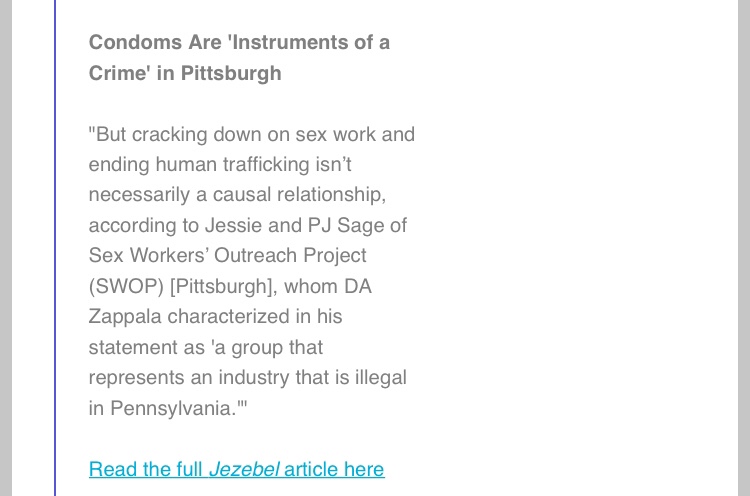
Advocates for Sex Workers Send Open Letter to Allegheny District Attorney Stephen Zappala Opposing Criminalization of Condom Possession
The letter notes that criminalizing condoms “has a chilling effect on Pittsburghers' willingness to carry and use condoms, especially those who are most vulnerable to contracting HIV/AIDS and other STIs including women and men of color, LGBTQ people, young people, victims of trafficking, and people in the sex trades.”
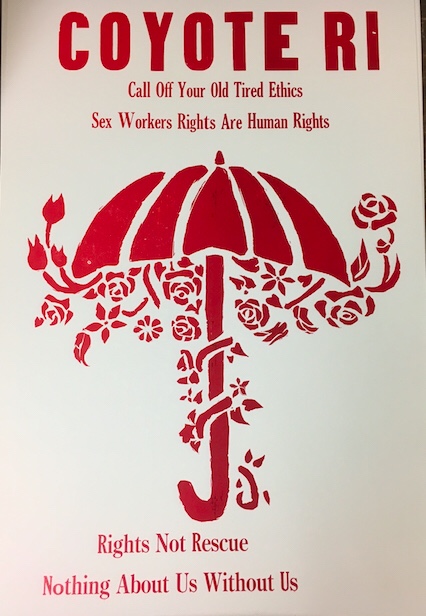
National Sex Workers’ Summit Culminates in Manifesto Calling for Decriminalization of Prostitution by Stephen Lemons
Decrying “punitive intervention,” the statement reaffirms the dignity and humanity of people who engage in commercial sex and insists that sex workers be empowered to take the lead in any and all decision-making that concerns them. It delineates the “rights of sex workers,” including the freedom to work as they choose, “without onerous regulation that is disrespectful of our agency and our autonomy.”
Platforms Which Now Discriminate Against Sex Workers –
We’ve found over 100 companies, institutions, and discrete products who now discriminate against sex workers and performers (like Skype… — Read on survivorsagainstsesta.org
Congratulations Crossroads Womens Center
After years of hard work to make this a reality, the Crossroads Women's Center is hosting a ground-breaking celebration for our new space on Wayne Avenue on July 10th!
We Thank You Trib LIVE Megan Guza: Allegheny County halts criminalizing of condoms in prostitution cases
Allegheny County halts criminalizing of condoms in prostitution cases Megan Guza Allegheny County police officers will no longer criminalize condoms in prostitution-related cases, the department superintendent said Thursday. The change comes 2 ½ weeks after a Tribune-Review investigation found that the charge was being levied against women and men caught in prostitution stings based on individuals carrying condoms. Jessie and PJ Sage, co-founders of the Pittsburgh SWOP chapter, called Thursday’s news a win.
Media Links: Criminalization of Condom Possession in Pittsburgh
Media Links: Criminalization of Condom Possession in Pittsburgh
Dear District Attorney Zappala
The Sex Worker’s Outreach Project (SWOP) Pittsburgh is disappointed in the District Attorney Zappala’s response to the open letter we and several other organizations (including ACLU of Pennsylvania, Women's Law Project, #SurvivorsAgainstSESTA and Planned Parenthood of Western Pennsylvania) opposing several practice that endanger the citizens of Allegheny County: 1.) police and prosecutors’ practice of citing condom possession as evidence of intent to engage in prostitution-related crimes, 2.) police seizure of condoms and other contraceptives, and 3.) the practice of adding the more severe possessing-instrument-of-crime (“PIC”) charges under 18 Pa.C.S. § 907 when defendants are charged with prostitution.
 Worker Survivor Community Archive
You must be logged in to post a comment.